
Different classes of dyes are used for different types of fiber and at different stages of the textile production process, from loose fibers through yarn and cloth to complete garments. Dyes are selected according to affinity; any given dye does not apply to every type of fiber. They are not the same article. Acrylic fibers are dyed with basic dyes, while nylon and protein fibers such as wool and silk are dyed with acid dyes, and polyester yarn is dyed with dispersed dyes. Dyes are classified according to many parameters, such as chemical structure, affinity, application method, desired colour fastness i.e. Direct dyes, a class of dyes largely for dyeing cotton, are water-soluble and can be applied directly to the fiber from an aqueous solution.
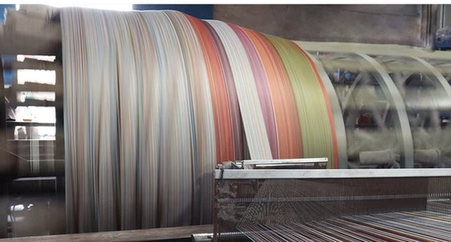
Each component of a textile product, including fibre, yarn, fabric, processing, and finishing, affects the final product. Racks of bobbins are set up to hold the thread while it is wound onto the warp beam of a loom. Woven ‘grey cloth’ was then sent to the finishers where it was bleached, dyed and printed.

Why the Two Look Identical in a Supplier’s Catalogue
Two types exist: rotary screen printing and flat (bed) screen printing. This approach to digital textile printing is very different, and so is the expectation. In properly printed fabrics the colour is bonded with the fibre, so as to resist washing and friction. Post heat setting may cause poor wash fastness in disperse dyed fabrics because of sublimation. There are specific terms to describe these dyeing methods, such as: Dope dyeing: In dope dyeing, pigments are added to the polymer solution itself before extruding the fibers. Such yarns are typically used as weft yarns with a cotton warp. When twills are printed, this is typically done on lightweight fabrics. Fabric after leaving the loom or knitting machine is not readily useable. The sheet is laid on the fabric and colour is brushed through its interstices. Jacquard looms and Dobby looms are looms that have sophisticated methods of shedding.
The vocabulary does not help: tapestry, woven look, custom printed throw and jacquard blanket are used interchangeably across the trade, sometimes in the same listing. Both the Jacquard process and the necessary loom attachment are named after their inventor. There are several different mesh counts that can be used depending on the detail of the design being printed. A specification sheet will usually tell you the composition, the weight of the fabric and the size, and will rarely say whether the colour sits within the fibre or upon the surface of the pile. Mercerisation makes the woven cotton fabric stronger, more lustrous, and less abrasive, and improves its dye affinity.
It signifies the textile’s ability to endure repeated washing without experiencing fading, bleeding, or other undesirable alterations. Fastness of color largely depends upon the molecular size of the dyes and the solubility.
How Each Blanket is Actually Made
Yarn-dyed woven. The packages are hydro extracted to remove the maximum amount of water leaving the desired color into raw yarn. During raising, the fabric surface is treated with sharp teeth to lift the surface fibres, thereby imparting hairiness, softness, and warmth, as in flannelette. Package dyeing is a method where yarns are wound on perforated cones placed in a dye vessel. The jacquard allowed individual control of each warp thread, row by row without repeating, so very complex patterns were suddenly feasible. Raising lifts the surface fibers to improve the softness and warmth, as in flannelette. After this process, the dyed yarn packages are packed and delivered. Looming, and the weaving process on power looms is the same as with cotton. According to the face yarn (warp or weft): Warp face twill weave: 4/2 S, etc. Warp knits do not stretch as much as a weft knits, and they are run-resistant. However, dobby looms are not capable of producing many different weaves from one warp.
Printed. Polyester fabric is printed mostly with dye-sub or disperse direct ink, although UV and solvent inks (including HP’s latex formulation) can also be used. Conventional water-based inks are often used on light-coloured cotton, while high-opacity formulations are available for darker fabrics. The Jacquards were often small and controlled relatively few warp ends. This is a 2/2 twill, with two warp threads crossing every two weft threads. The weft passes across the loom in a shuttle that carries the yarn on a pirn. The warp threads are held taut and in parallel to each other, typically in a loom.
An analogy that tends to stick with buying teams: a yarn-dyed blanket is like a mosaic made from coloured tiles, where the picture is the tiles themselves; a printed blanket is like the same picture reproduced as a photograph and laid over a white tile. Both show the image; only one of them still shows it when you turn it over, rub it, or wash it fifty times.
Six Differences That Only Show Up After the Sale
The lengthwise threads are known as the warp, and the crosswise threads are known as the weft. A twill weave requires three or more harnesses, depending on its complexity and is the second most basic weave that can be made on a fairly simple loom. The satin weave is characterised by four or more fill or weft yarns floating over a warp yarn, and four warp yarns floating over a single weft yarn. Woven cloth can be plain or classic (in one colour or a simple pattern), or can be woven in decorative or artistic design. Nylobond is a special ink additive for printing onto technical or waterproof fabrics. Even-sided twills have the same amount of warp and weft threads visible on both sides of the fabric. The most common process is a plain weave, in which the yarns interlace in an alternating, tight formation, producing a strong and flexible multi-use fabric. Each can carry a different colour which allows banding across the loom. The warp, which must be strong, needs to be presented to loom on a warp beam. Fabrics with a plain weave are generally strong, durable, and have a smooth surface.
|
What you are checking |
Yarn-dyed woven |
Printed fleece |
|---|---|---|
|
Where the |
Inside the fibre, dyed before weaving |
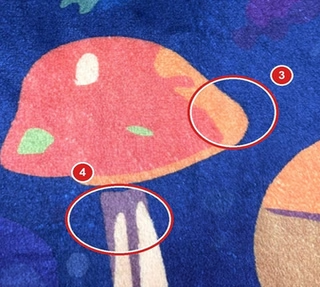
On the surface of the pile |
|
Fine detail |
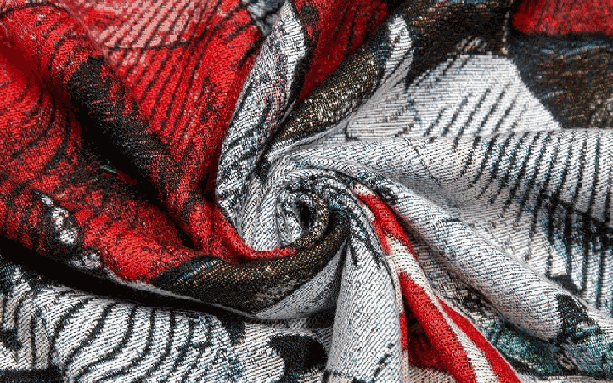
Thin lines, small type, crests and gradients stay sharp because they are built yarn by yarn |
Fine lines soften on pile; the |
|
Reverse side |
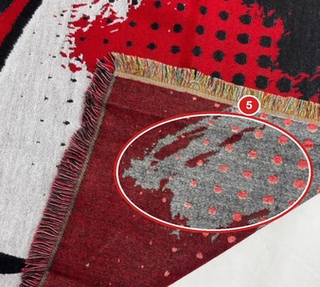
Full pattern in reversed colours, both sides usable |
Plain white greige, printed on one side only |
|
Colour |
No coating to crack, peel or wash off; colour cannot fade at the surface because there is no surface layer |
Print can crack or fade after repeated washing and friction |
|
Hand feel and drape |
Silky, close to cashmere after brushing, with a soft natural drape |
Soft but flatter, with less body and less fall |
|
Best fit |
Licensed programmes, mid-to-premium gifting, retail and collectible lines |
High-volume promotions, one-off campaigns, entry-price lines |
The warp yarns are shown running top to bottom, weft running sideways folding at each side.
There are special-use mesh materials of nylon and stainless steel available to the screen-printer. In plain weave cloth, the warp and weft threads cross at right angles, aligned so they form a simple criss-cross pattern. The longitudinal threads are called the warp and the lateral threads are the weft, woof, or filling. A wide variety of colored pigments can be used instead of carbon black. A float is the portion of a warp yarn that crosses over two or more weft yarns.
It is a process of printing on textiles and garments using specialized or modified inkjet technology. For any production order the brand authorisation must be supplied by the customer; we manufacture only. Direct dye-sublimation fabric printing In this type of digital textile printing, an inkjet printer is used to print dye-sublimation inks directly onto the fabric. Due to the fast development of digital textile printing, dye sublimation inks are becoming more and more popular in digital inkjet printing on fabrics. Digital textile printing is often referred to as direct-to-garment printing (DTG printing), or digital garment printing.
The Flip Test: Turn the Blanket Over
If you remember one thing from this article, make it this: when a sample arrives, do not start with the front. The threading of a Jacquard machine is so labour-intensive that many looms are threaded only once. Jacquard-driven looms, although relatively common in the textile industry, are not as ubiquitous as dobby looms which are usually faster and much cheaper to operate.
There is no blank side. The preparation of Jacquard cards and practical hints to learners of Jacquard designing.

The cloth has always to be brushed, to free it from loose nap, flocks and dust that it picks up whilst stored. Two usable sides means one less thing for the customer to get wrong, one more photograph for the listing, and a product that still looks considered when it is draped rather than folded. A washed textile no longer has coating or ink residues and will, therefore, have a better feel. Finishing treatments can reduce felting, improve machine washability, protect against insects, or alter handle and appearance.
Which Orders Justify Yarn-Dyeing (And Which Do Not)
We want to be honest about this, because overselling a construction method wastes everyone’s time. Dyed wool reels (CSIRO) There are many forms of yarn dyeing. A stencil is formed by blocking off parts of the screen in the negative image of the design to be printed; that is, the open spaces are where the ink will appear on the substrate.
Yarn-dyeing earns its place when the artwork or the programme asks something harder of the fabric: licensed crests with fine outlines and small lettering; city skylines and souvenir maps where the small type is the whole point; photographic gradients and skin tones; gift lines where the reverse will be seen; collectible programmes kept season after season. These were used for economical high color fastness dark shades such as black and navy.
A practical rule of thumb: the more the design depends on small detail, and the longer you expect the customer to keep the blanket, the stronger the case for weaving the colour in.
Three Checks to Run When Your Sample Arrives
The flip test. Turn it over and photograph the reverse. The areas of emulsion that were not exposed to light dissolve and wash away, leaving a negative stencil of the image on the mesh. A complete inverted pattern confirms a woven structure; a plain white back confirms a one-sided print.
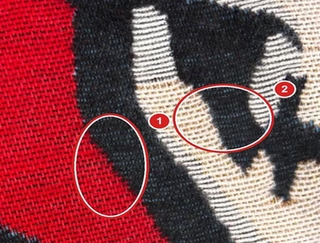
The edge and fine-line test. Under a phone macro or a loupe, look for stepped yarn edges and visible weft in the pale areas, rather than a soft, fuzzy edge that fades into the pile. Check that the smallest lettering and the finest outline are still there.
The wash test. Wash once on a gentle cycle below 30°C with similar colours, dry at low heat or hang to dry, then look again at colour, surface, fringe and edges. A woven structure has no coating to crack; the hand-twisted fringe should still hold the edge straight and should not curl. Do not iron directly on the pattern — if needed, iron lightly from the reverse.
While the sample is in hand, the remainder of the specification should be confirmed in writing: composition (100% polyester or 100% GRS-certified recycled polyester), fabric weight (240–260 GSM as standard, other weights on request), size and the ±3% tolerance, the handcrafted fringe on all four sides, and the packing format. You can see the full list on our certifications page.
See It Up Close. Then Decide
Specifications, the size guide, carton data, the sample workflow and the full FAQ are all on our yarn-dyed woven tapestry blanket page. It is the fastest way to check a supplier’s offer against a published standard before you commit to a sample.
If you already have artwork in mind, send us your artwork together with your size, quantity and target market. We will tell you whether yarn-dyeing is the right route for that particular design, and what we would need to put a sample in motion before you commit to a production run.