
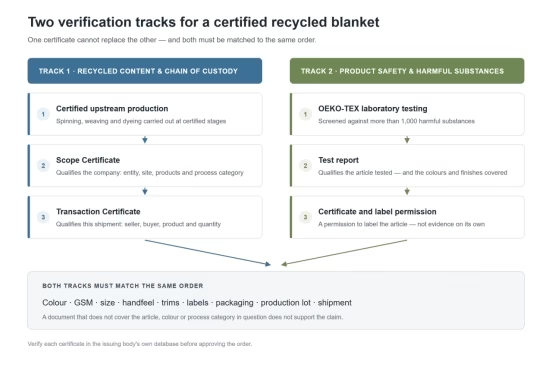
A qualified GRS certified recycled blanket manufacturer should provide two separate evidence tracks: one proving the recycled polyester content and its chain of custody, and another showing that the finished blanket is tested for harmful substances for its intended use. Buyers should then confirm that both tracks match the approved colour, GSM, size, handfeel, trims, labels, packaging, production lot, and shipment. One certificate cannot replace the other – and in the sections below, every document named is listed with the certificate number and validity period you can check yourself.
Use a Two-Part Verification Rule
Treat sustainability and product safety as parallel approval gates. GRS supports a claim about recycled material and its movement through certified supply-chain stages. 오코텍스 스탠다드 100 addresses harmful substances in a textile article and its components. It does not authenticate recycled content.
For every purchase order, ask: “What does this document cover, and can we match it to this blanket?”
A supplier logo, an undated certificate screenshot, or a report for a similar fabric is not enough. The legal entity, site, product, composition, process category, validity, and order details should agree across the whole evidence pack.
What Each Document Actually Proves
Most disputes do not come from a missing certificate. They come from four documents being treated as one. They prove four different things.
| 문서 | Issued by | What it proves | What it does not prove |
| Scope Certificate (SC) | Certification body, under Textile Exchange licence | That a named legal entity is certified for specified standards, products, and process categories during a stated period | That any particular shipment contains certified material |
| Transaction Certificate (TC) | Certification body, on request of the seller | That a specific trade transaction of a specified quantity and product was transacted under the standard | That the finished article passes chemical testing |
| Test report | Testing institute (e.g. for OEKO-TEX) | That the tested article, as submitted, met the limit values of the applicable product class | That the material is recycled, or that untested colours and trims are covered |
| Certificate / label | Certification body / brand licence | That a certified article may carry the mark, once all conditions are met | That the mark may be used on a different article, colour, or unapproved version |
Rule of thumb: an SC qualifies a company, a TC qualifies a transaction, a test report qualifies an article, and a label is a permission – not evidence.
How to Read a GRS Scope Certificate
Start with the manufacturer’s Scope Certificate and verify it in the Textile Exchange “Find a Certified Company” list, which is the single source of truth for scope certificates. Do not rely on a PDF sent by email. Check these fields in order:
| SC field | What to confirm |
| Certified organization | Legal entity name matches the company you are contracting with – not a trading name or a group website |
| Facility address | Matches the site that will actually produce or handle your order |
| Standard and version | GRS, and the version in force (e.g. GRS 4.0) |
| Validity period | The certificate covers your production and shipment window, not just the order date |
| Product categories | Your article type is listed – for example home textiles, greige fabrics, or dyed fabrics |
| Product details | Your construction is described (knitted or woven, composition, dyed or undyed) |
| Process category | The most misread field in the whole certificate – see below |
| Subcontractors | Any listed subcontractor is itself certified for the relevant process |
The process category is the field buyers misread
A Scope Certificate is issued per process category, and a company holds only the categories it was audited for. Common categories include manufacturing stages such as knitting, weaving, dyeing, printing, cutting, and sewing – and separately, trading.
This distinction changes what you are buying:
- A supplier certified for production categories has been audited on those production processes.
- A supplier certified for trading only is certified to buy, hold, and sell GRS material within the chain of custody, while the production stages are carried out by certified upstream suppliers. Traceability then rests on the upstream certificates plus the transaction certificate for your order.
Neither is inherently better or worse. What matters is that the certificate’s declared categories match the work the supplier actually performs on your order – because if they do not, the certification does not cover that step. Ask for the category list in writing, compare it with the subcontracting list, and reconcile both against the production route in your specification.
Recycled Content Claims: 20% Versus 50%
Two different thresholds govern recycled content, and confusing them is the most common cause of a claim that has to be withdrawn.
- 20% recycled content is the minimum for a product to be certified under GRS and to use GRS as a business-to-business tool.
- 50% recycled content is required for consumer-facing GRS labelling and product-specific claims.
So a blanket can be genuinely GRS certified and still be unable to carry the GRS logo on its retail packaging if it falls between the two thresholds. Before approving artwork, confirm the claimed percentage against the actual certified content, and confirm which claim wording is permitted for that percentage. Where the wording is restricted, the honest options are a lower-tier claim (for example RCS for recycled content alone) or an accurate statement of the certified percentage rather than a logo.
Document all of this in the specification, not in correspondence: the recycled percentage and type (for example recycled polyester or RPET), the yarn or fabric reference, and the permitted claim wording.
The Transaction Certificate: Who Requests It, When, and What If It Cannot Be Issued
An SC does not cover your shipment. The order-level link is the Transaction Certificate, and it has to be planned rather than requested afterwards.
Define the following before the purchase order is approved:
- Who requests it – normally the seller in the transaction; the buyer cannot obtain it independently.
- What it must cover – the correct seller, buyer, product, composition, quantity, and shipment.
- When it will be available – agree a deadline that fits your compliance and retail-onboarding calendar, not the shipping date.
- What happens if it cannot be issued – decide in advance whether you will accept a different, accurate claim (for example recycled content only, without a chain-of-custody statement), or whether the material must be sourced through a route that can produce the TC.
Write the answers into the purchase order. A TC obligation that exists only in email is an obligation that tends to disappear at exactly the moment you need it.
Which Legal Entity Holds Which Certificate
Buyers lose more time to entity mismatches than to any other verification issue. Certification bodies issue certificates to legal entities, and a group can hold different standards under different entities operating at the same site.
Check every certificate against a single question: is this the entity that will produce my order, and if not, what is the relationship?
Our group structure, stated plainly so that you can verify it:
- Shaoxing Dotex Textile Co., Ltd. holds the GRS Scope Certificate and the OEKO-TEX STANDARD 100 certificate, and holds amfori BSCI social-compliance monitoring.
- Shaoxing City Tujin Textile Co., Ltd. holds ISO 9001 and ISO 14001, and operates as our affiliated production factory at the same Qisheng Road address.
The entity holding a certificate is the entity named in the public databases. If a supplier’s website shows one name and the certificate database shows another, with no explanation, treat that as an open question until it is answered in writing.
Verify OEKO-TEX Coverage Against the Intended Use
OEKO-TEX states that STANDARD 100 tests textiles from yarn to finished product against more than 1,000 harmful substances, with stricter requirements as skin contact becomes more intensive. Verify the certificate number in the official OEKO-TEX Label Check, then confirm its validity, named holder, certified article description, and product class.
Product class must follow intended use:
| Product class | Applies to | Typical relevance |
| Class I | Articles for babies and children up to three years | The strictest limit values |
| Class II | Articles with direct skin contact over a large area | Common starting point for adult high-contact blankets |
| Class III | Articles without direct skin contact | Outer and decorative uses |
| Class IV | Furnishing materials | Upholstery and interior textiles |
Two practical points follow.
First, “sensitive skin” is not a shortcut to a class claim. State the target user and the destination market, and obtain written confirmation of the certified scope that applies.
Second, certification at a stricter class is the stronger position. Our OEKO-TEX certificate is issued at Product Class I – the strictest class – and the certified articles include blankets and a cooling series finished with PCM (phase-change material) treatments. Where your program targets an adult or high-contact blanket, a certificate already issued at Class I removes the class question from the discussion rather than leaving it to interpretation.
Coverage also has to match the article you are actually buying. For a finished blanket, confirm coverage after dyeing, printing, brushing, and chemical finishing, as applicable. Account for sewing thread, bindings, zippers or snaps, embroidery, heat transfers, woven labels, care labels, and other accessories: these become part of the finished article. A certificate for greige fabric or yarn should not be presented as automatic proof for an altered finished article – and packaging may sit outside the textile certificate scope, so verify packaging claims separately instead of assuming the blanket certificate covers them.
Keep Custom Specifications Aligned with Evidence
Customization creates value, but each change can alter the approved material system. Use a controlled bill of materials, and review this matrix before approving the pre-production sample.
| Custom element | What must match | Review trigger | Evidence affected |
| Colour and print | Dye or ink route, fabric code, approved shade | New colorant, printer, or print method | OEKO-TEX test coverage, which applies per colour and print route |
| GSM and composition | Recycled percentage, yarn and fabric reference | Different yarn, blend, backing, or weight | GRS content claim and the transaction certificate; OEKO-TEX article description |
| Size and construction | Dimensions, layers, seams, edge finish | Added layer, binding, filling, or closure | OEKO-TEX certified article description |
| Handfeel | Brushing and finishing recipe | Softener, anti-pilling, coating, or process change | OEKO-TEX coverage, because finishing chemistry changes the article |
| 라벨 및 포장 | Material, inks, claims, supplier, placement | New label, transfer, insert, bag, or sustainability claim | Claim permission for the certified content percentage; packaging sits outside textile certificate scope |
The sample approval sheet should identify the same fabric, finish, trims, and packing materials used in production. Colour, GSM, dimensions, handfeel, labels, and packaging should be frozen alongside the documentary requirements – not after them.
Certificate Validity and Renewal Windows
Certificates are time-limited, and a lapse is not a paperwork problem: it creates a gap in the chain of custody for everything shipped during that gap. Build a certificate calendar and re-verify at each purchase order, not once per year.
| 기준 | Valid to | Renewal note |
| GRS Scope Certificate | 15 November 2026 | Renewal is arranged with the certification body and is not automatic |
| 오코텍스 스탠다드 100 | 30 June 2027 | Confirm the renewed certificate lists the same article descriptions before reusing existing artwork |
| amfori BSCI | 16 December 2027 | Social-compliance monitoring cycle |
| ISO 9001 / ISO 14001 | 23 July 2029 | Subject to surveillance audits within the cycle |
Two rules keep this from becoming a launch-day surprise:
- Compare the expiry date against your shipment window, not your order date. If the certificate expires before shipment, the evidence pack has a hole regardless of how complete it looked at PO stage.
- Get the renewal plan in writing if the expiry falls inside the production window. “It will be renewed” is not a plan; a date and a responsible party is.
Run a Pre-Order Document Check
Before releasing bulk production, complete this review:
- Authenticate the current GRS Scope Certificate and the OEKO-TEX certificate through the official databases.
- Match company names, facility addresses, product scope, materials, processes, process categories, validity, and product class.
- Check the subcontractor list against the actual production route, and confirm any subcontractor is certified for the relevant process.
- Confirm the certificate remains valid across the whole production and shipment window.
- Freeze the bill of materials, specification, artwork, approved sample code, and packaging instructions.
- Record yarn or fabric lots, dye lots, production batch IDs, quantities, and subcontracted stages.
- Review whether the finished-article test report covers all colours, finishes, and accessories ordered.
- State TC responsibility, eligibility, timing, and required transaction details in the purchase order.
- Require written approval for substitutions or process changes before production.
- Reconcile final inspection, packing list, invoice, shipment quantities, and certificate records.
Verified Certification Reference
The purpose of this article is verification, so here is what there is to verify. Every entry below can be checked in the issuing body’s own database.
| 기준 | Certificate holder | Certificate or ID | Issuing body | Valid to | Certified scope |
| GRS (Scope Certificate) | Shaoxing Dotex Textile Co., Ltd. | CU1021210GRS-2025-00124011 (TE-ID TE-00322223) | Control Union Certifications B.V. | 15 November 2026 | GRS 4.0. Home textiles, greige fabrics, dyed fabrics, men’s apparel. Process category: Trading. No subcontractors |
| 오코텍스 스탠다드 100 | Shaoxing Dotex Textile Co., Ltd. | 19.HCN.76049 | Hohenstein Laboratories GmbH & Co. KG | 30 June 2027 | Product Class I (strictest). Blankets, bathrobes, duvet covers, pillowcases, sheet sets, table linen, napkins, socks; includes a cooling series with PCM finishes |
| ISO 9001 | Shaoxing City Tujin Textile Co., Ltd. (affiliated production factory) | 65626Q08395R010 | VICAS | 23 July 2029 | Production of knitted textiles and home textile products |
| ISO 14001 | Shaoxing City Tujin Textile Co., Ltd. (affiliated production factory) | 65626E08396R010 | VICAS | 23 July 2029 | Production of knitted textiles and home textile products |
| amfori BSCI | Shaoxing Dotex Textile Co., Ltd. | amfori ID 156-003176-000; Monitoring ID 25-0365755 | – | 16 December 2027 | amfori Social Audit – Manufacturing; Full Monitoring, semi-announced. Audit scope: cutting, sewing, inspecting, packing. No subcontracted production |
Where to verify each one:
- GRS Scope Certificate – Textile Exchange, “Find a Certified Company” (search by TE-ID or certificate number). See also Textile Exchange’s certificate authentication note.
- OEKO-TEX STANDARD 100 – OEKO-TEX Label Check
- amfori BSCI – amfori support portal
- ISO 9001 / 14001 – through the issuing certification body named above
Because the GRS scope above is issued for the Trading process category, our recycled-content chain of custody rests on certified upstream production plus the transaction certificate issued for your order. We state the category here rather than leaving it for you to discover, because the category is exactly what determines whether the certification covers the step in question. [[CONFIRM: whether to add a one-line explanation of which upstream certified stages supply the recycled yarn]]
자주 묻는 질문
These questions address the common gaps that appear after a supplier has shared certificate names but before an order is fully documented.
Does a GRS Scope Certificate prove my blanket shipment is certified?
No. It confirms the organization’s certified scope, products, and process categories during a stated period. The order must still match eligible materials, processes, records, and transaction-level evidence.
Does OEKO-TEX STANDARD 100 verify recycled content?
No. It addresses harmful substances in the certified textile article. GRS provides the separate framework for recycled content, chain of custody, and related processing requirements.
Which OEKO-TEX product class applies to baby blankets?
Product Class I applies to articles intended for babies and children up to three years. Confirm that the certificate and article scope explicitly support the intended blanket.
Can a custom label or print affect the certificate review?
Yes. Labels, inks, transfers, threads, and other additions become part of the finished article, and test coverage applies per colour and print route. Confirm coverage or arrange testing before approving the customized version.
When should the transaction certificate be agreed?
Before purchase-order approval. Define the responsible party, eligible claim, transaction details, delivery timing, and the fallback if the document cannot be issued.
How much recycled content does a blanket need before it can carry the GRS label?
Two thresholds apply. A minimum of 20% recycled content is required for GRS certification and for business-to-business claims, while consumer-facing GRS labelling requires at least 50% recycled content. A blanket can therefore be genuinely certified and still be unable to carry the GRS logo on retail packaging.
Our supplier’s GRS certificate lists “Trading” as the process category. Is that a problem?
Not by itself. Trading is a recognised GRS process category and is common for suppliers that buy, hold, and sell certified material while production is carried out by certified upstream stages. The question to resolve is whether the declared categories cover the steps your supplier performs on your order, and how the transaction certificate will support your specific shipment.
What happens if a certificate expires during an order?
The chain of custody has a gap for shipments made after expiry, even if the order was placed before. Compare expiry dates against the production and shipment window, and if the expiry falls inside that window, obtain the renewal plan in writing with a date and a responsible party.
Build the Verification Pack Before Sampling
Effective qualification starts with a precise RFQ. Provide the destination market, end-user age, contact level, target product class, recycled-content claim, fibre composition, construction, GSM, dimensions, colours, finish, labels, packaging, order quantity, test requirements, and required shipment records. Ask the supplier to identify which scope certificate, transaction certificate, test report, and label permission will support each claim.
This gives design, ESG, quality, and procurement teams one controlled reference – and it exposes gaps early, before custom materials or packaging enter production.
To assess a project, send your specification and evidence requirements for review, and ask for confirmation against the exact article and order rather than a general statement that the factory is certified.